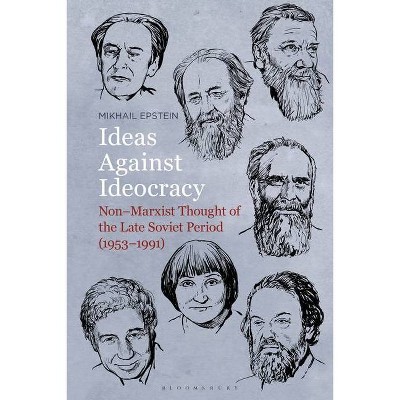
Ideas Against Ideocracy - by Mikhail Epstein (Hardcover)
Similar Products


Products of same category from the store
All







Product info
<p/><br></br><p><b> About the Book </b></p></br></br>"This groundbreaking work by one of the world's foremost theoreticians of culture and scholars of Russian philosophy gives for the first time a systematic examination of the development of Russian philosophy during the late Soviet period. Countering the traditional view of an intellectual wilderness under the Soviet regime, Mikhail Epstein provides a comprehensive account of Russian thought of the second half of the 20th century that is highly sophisticated without losing clarity. It provides new insights into previously mostly ignored areas such as late Soviet Russian nationalism and Eurasianism, religious thought, cosmism and esoterism, and postmodernism and conceptualism. Epstein shows how Russian philosophy has long been trapped in an intellectual prison of its own making as it sought to create its own utopia. However, he demonstrates that it is time to reappraise Russian thought, now freed from the bonds of Soviet totalitarianism and ideocracy but nevertheless dangerously engaged into new nationalist aspirations and metaphysical radicalism. We are left with not only a new and exciting interpretation of recent Russian intellectual history, but also the opportunity to rethink our philosophical heritage"--<p/><br></br><p><b> Book Synopsis </b></p></br></br><p>This groundbreaking work by one of the world's foremost theoreticians of culture and scholars of Russian philosophy gives for the first time a systematic examination of the development of Russian philosophy during the late Soviet period. <p/>Countering the traditional view of an intellectual wilderness under the Soviet regime, Mikhail Epstein provides a comprehensive account of Russian thought of the second half of the 20th century that is highly sophisticated without losing clarity. It provides new insights into previously mostly ignored areas such as late-Soviet Russian nationalism and Eurasianism, religious thought, cosmism and esoterism, and postmodernism and conceptualism. <p/>Epstein shows how Russian philosophy has long been trapped in an intellectual prison of its own making as it sought to create its own utopia. However, he demonstrates that it is time to reappraise Russian thought, now freed from the bonds of Soviet totalitarianism and ideocracy but nevertheless dangerously engaged into new nationalist aspirations and metaphysical radicalism. We are left with not only a new and exciting interpretation of recent Russian intellectual history, but also the opportunity to rethink our own philosophical heritage.</p><p/><br></br><p><b> Review Quotes </b></p></br></br><br><p>"This second volume of Mikhail Epstein's magisterial philosophical survey is an immense event. Each of its four sections-conservative nationalism, Orthodox religiosity, mystical cosmism, postmodernism-presents major Russian thinkers and artists working their way out of an astonishing paradox: how militant materialism of the Soviet sort could have promoted its apparent opposite, a Platonic utopia where ideas reigned supreme over factual matter, wholeness over difference, and totalizing projections over individual lived experience. The quest of these non-Marxist creators for solid ground is both frightening and inspirational." --<i>Caryl Emerson, Princeton University, USA</i> <p/>"This book offers an extraordinary comprehensive account of Russian intellectual life in the latter Soviet period and brings to light central philosophical trends, themes, and ideas largely unknown or not readily available to the Anglophone readership. Clearly written and brilliantly argued, the volume provides valuable insights into genuine philosophical thought that continued flourishing under Soviet ideocracy, thus countering a still prevailing dismissive view of Soviet intellectual discourse and affirming the global appeal and contemporary relevance of Russian thought." --<i>Marina F. Bykova, Professor of Philosophy, North Carolina State University, USA</i> <p/>"Mikhail Epstein's second volume of his unprecedented survey of late Soviet philosophy daringly connects the works by philosophers, political thinkers and dissidents, writers, and visual artists. The work covers three major areas: the philosophy of national spirit, religious philosophy, and postmodernist thought. Philosophical ideas expressed through the poetics of literary or visual art are as important for Epstein as traditional forms of philosophic discourse. Despite Epstein's significant impact on all three areas of philosophy discussed in the book, the reader will not find in it a special chapter dedicated to his own philosophy. Nevertheless, this book reads as Mikhail Epstein's ultimate contribution - in the form of critique - to these fields of philosophy, Russian as well as global." --<i>Mark Lipovetsky, Professor of Russian, Columbia University, USA, and co-author of Oxford History of Russian Literature</i></p><br><p/><br></br><p><b> About the Author </b></p></br></br><b>Mikhail Epstein</b> is Samuel Candler Dobbs Professor of Cultural Theory and Russian Literature at Emory University, USA. From 2012-2015 he was Professor of Russian and Cultural Theory and Founding Director of the Centre for Humanities Innovation at Durham University, UK. His research interests include new directions in the humanities and methods of intellectual creativity, contemporary philosophy, postmodernism, Russian literature, and philosophy and religion of the 20th-21st cc. He is the author of 33 books, including <i>The Transformative Humanities: A Manifesto </i>(Bloomsbury, 2012), and more than 700 articles and essays. His work has been translated into 23 languages.
Price History
Price Archive shows prices from various stores, lets you see history and find the cheapest. There is no actual sale on the website. For all support, inquiry and suggestion messages communication@pricearchive.us