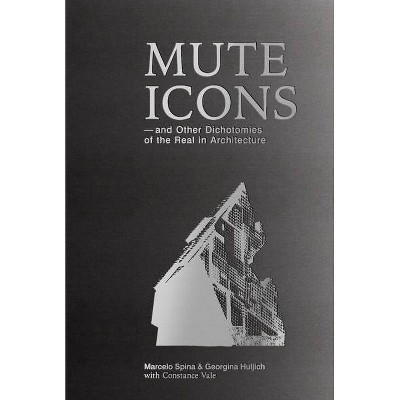
Mute Icons - by Spina Marcelo & Huljich Georgina & Constance Vale (Paperback)
Similar Products

![Assunta Spina [DVD] [1915]](https://pisces.bbystatic.com/image2/BestBuy_US/images/products/3274/32748617_so.jpg)




Products of same category from the store
All



Product info
<p/><br></br><p><b> Book Synopsis </b></p></br></br><b>Mute Icons challenges fixed aesthetic notions of beauty in architecture as both, disciplinary discourse and a spatial practice within the public realm, by intersecting historic antecedents and present instances within contemporary projects wherein indeterminacy, monolithicity and defamiliarization play a speculative role in constructing withdrawn, irritant and yet engaging architectural images.</b> <p/> No longer concerned with narrative excesses or with the shock and awe of sensation making; the mute icon becomes intriguing in its deceptive indifference towards context, perplexing in its unmitigated apathy towards the body. Object and building, absolute and unstable, anticipated and strange, manifest and withdrawn, such is the dichotomy of mute icons. Dwelling in the paradox between silence and sign and aiming to debunk a false dichotomy between critical discourse, a pursuit of formal novelty and the attainment of social ethics, "Mute Icons" reaffirms the cultural need and socio-political relevance of the architectural image, suggesting a much-needed resolution to the present but incorrect antagonism between formal innovation, social responsibility and economic austerity. Intersecting relevant historical antecedents and polemic theoretical speculations with original design concepts and provocative representations of P-A-T-T-E-R-N-S recent work, the book aspires to stimulate authentic speculations on the real. <p/> Part history, part theory, and part monographic atlas, Mute Icons includes contributions by Georgina Huljich, Guillermo Martinez, Ciro Najle, Marco Spina, Brett Steele, and Constance Vale.<p/><br></br><p><b> Review Quotes </b></p></br></br><br><em>"Mute Icons</em>, an oxymoronic title, is positioned to neither <br>clearly communicate, nor be silent. The work argues for a radical <br>redefinition of the icon, and therefore of the image in contemporary architecture, as a 'cultural and social irritant' that facilitates a critical postulation of varied readings of its image." -- Stir World<br><br>"In <i>Mute Icons</i>, Marcelo Spina and Georgina Huljich mine precedents<br> that span nearly 5,000 years, from Ancient Egypt to 2009, doing it in a<br> way that renders them "familiar yet strange" and enables their analysis<br> to be applied to the projects of their studio, PATTERNS. Put another <br>way, in their hands historical precedents are very much relevant, <br>something I find refreshing, and which makes this book appealing to me. <br>The precedents comprise the first part of the three-part book, with the <br>last part comprising a monograph of PATTERNS' projects and the second <br>part serving as "a conceptual bridge" between the other two, directly <br>showing how the precedents informed, or at least relate to, particular <br>projects." --John Hill, A Daily Dose of Architecture<br><br>
Price History
Price Archive shows prices from various stores, lets you see history and find the cheapest. There is no actual sale on the website. For all support, inquiry and suggestion messages communication@pricearchive.us