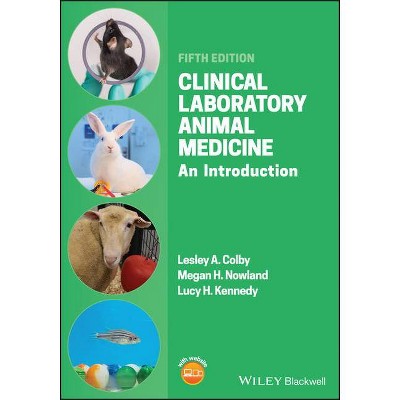
Clinical Laboratory Animal Medicine - 5th Edition by Megan H Nowland & Lucy H Kennedy & Lesley A Colby (Paperback)
Compare Prices Across Stores10000
All



More Books at Target11+
All









Product Details
<p/><br></br><p><b> About the Book </b></p></br></br>"The revised fifth edition of Clinical Laboratory Animal Medicine: An Introduction is an accessible guide to basic information for conducting animal research safely and responsibly. It includes a review of the unique anatomic and physiologic characteristics of laboratory animals, husbandry practices, and veterinary care of many animals frequently used in research, including rodents, rabbits, ferrets, zebrafish, nonhuman primates, and agricultural animals. The updated fifth edition adds two new chapters on zebrafish and large animals, new information on transgenic models and genetic editing, and expanded coverage of environmental enrichment and pain management. The book presents helpful tip boxes, images, and review questions to aid in comprehension and learning, and a companion website provides editable review questions and answers, instructional PowerPoints, additional images not found in the book, and video clips. Written for veterinary technicians, veterinary students, practicing veterinarians, and research scientists, the fifth edition of Clinical Laboratory Animal Medicine continues to offer an essential guide to the ethical treatment and anatomic and physiological characteristics of research animals"--<p/><br></br><p><b> Book Synopsis </b></p></br></br><p>The revised fifth edition of <i>Clinical Laboratory Animal Medicine: An Introduction </i>is an accessible guide to basic information for conducting animal research safely and responsibly. It includes a review of the unique anatomic and physiologic characteristics of laboratory animals, husbandry practices, and veterinary care of many animals frequently used in research, including rodents, rabbits, ferrets, zebrafish, nonhuman primates, and agricultural animals. </p> <p>The updated fifth edition adds two new chapters on zebrafish and large animals, new information on transgenic models and genetic editing, and expanded coverage of environmental enrichment and pain management. The book presents helpful tip boxes, images, and review questions to aid in comprehension and learning, and a companion website provides editable review questions and answers, instructional PowerPoints, and additional images not found in the book. This important text: </p> <p>- Provides a complete introduction to laboratory animal husbandry, diseases, and treatments<br />- Offers a user-friendly format with helpful content that highlights important concepts<br />- Contains new knowledge relating to technical methodologies, diseases, drug dosages, laws and regulations, and organizations<br />- Covers information on regulations, facilities, equipment, housing, and research variables as well as veterinary care<br />- Includes new chapters on zebrafish and cattle, sheep, goats, and pigs </p> <p>Written for veterinary technicians, veterinary students, practicing veterinarians, and research scientists, the fifth edition of <i>Clinical Laboratory Animal Medicine</i> continues to offer an essential guide to the ethical treatment and anatomic and physiological characteristics of research animals.</p><p/><br></br><p><b> From the Back Cover </b></p></br></br><p><b>An up-to-date, user-friendly guide to the anatomy and physiology, care, common diseases, and treatment of small mammals, select agricultural species, nonhuman primates</b></p> <p>The revised fifth edition of <i>Clinical Laboratory Animal Medicine: An Introduction</i> is an accessible guide to basic information for conducting animal research safely and responsibly. It includes a review of the unique anatomic and physiologic characteristics of laboratory animals, husbandry practices, and veterinary care of many animals frequently used in research, including rodents, rabbits, ferrets, zebrafish, nonhuman primates, and agricultural animals.</p> <p>The updated fifth edition adds two new chapters on zebrafish and large animals, new information on transgenic models and genetic editing, and expanded coverage of environmental enrichment and pain management. The book presents helpful tip boxes, images, and review questions to aid in comprehension and learning, and a companion website provides editable review questions and answers, instructional PowerPoints, and additional images not found in the book. This important text: </p> <ul> <li>Provides a complete introduction to laboratory animal husbandry, diseases, and treatments</li> <li>Offers a user-friendly format with helpful content that highlights important concepts</li> <li>Contains new knowledge relating to technical methodologies, diseases, drug dosages, laws and regulations, and organizations</li> <li>Covers information on regulations, facilities, equipment, housing, and research variables as well as veterinary care</li> <li>Includes new chapters on zebrafish and cattle, sheep, goats, and pigs</li> </ul> <p>Written for veterinary technicians, veterinary students, practicing veterinarians, and research scientists, the fifth edition of <i>Clinical Laboratory Animal Medicine</i> continues to offer an essential guide to the ethical treatment and anatomic and physiological characteristics of research animals.</p><p/><br></br><p><b> Review Quotes </b></p></br></br><br>"When a book's title includes the words "An Introduction," one often automatically assumes that it is not an extensive, all-encompassing tome where answers to almost every question can be found. But oh, what an introduction is provided in the fifth edition of Clinical Laboratory Animal Medicine: An Introduction!...I predict this book will be instrumental in training the next generation of laboratory animal scientists, veterinary technicians, and veterinarians." - JAVMA, Mar 15, 2020, Vol.256, No.6<br><p/><br></br><p><b> About the Author </b></p></br></br><p>The authors <p><b>Lesley A. Colby, DVM, MS, DACLAM, </b> is an Associate Professor and Senior Director of Animal Resources and Operations in the Department of Comparative Medicine at the University of Washington in Seattle, Washington, USA. <p><b>Megan H. Nowland, DVM, DACLAM, </b> is an Associate Professor in the Unit for Laboratory Animal Medicine at the University of Michigan in Ann Arbor, Michigan, USA. <p><b>Lucy H. Kennedy, DVM, DACLAM, </b> is an Assistant Professor in the Unit for Laboratory Animal Medicine at the University of Michigan in Ann Arbor, Michigan, USA.
Price History
Cheapest price in the interval: 52.99 on November 8, 2021
Most expensive price in the interval: 68.99 on May 23, 2021
Average price in period: 58.32