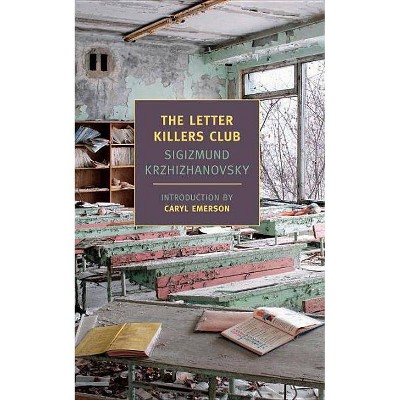
The Letter Killers Club - (New York Review Books Classics) by Sigizmund Krzhizhanovsky (Paperback)
Similar Products


Products of same category from the store
All




Product info
<p/><br></br><p><b> About the Book </b></p></br></br>"Writers are professional killers of conceptions. The logic of the Letter Killers Club, a secret society of "conceivers" who commit nothing to paper on principle, is strict and uncompromising. Every Saturday they meet in a fire-lit room hung with blank black bookshelves to present their "pure and unsubstantiated" conceptions: a rehearsal of Hamlet hijacked by an actor who vanishes with the role; the double life of a medieval merry cleric derailed by a costume change; a machine-run world that imprisons men's minds while conscripting their bodies; a dead Roman scribe stranded this side of the River Acheron. The overarching scene of this short novel is set in Soviet Moscow, in the ominous 1920s. Known only by pseudonym, like Chesterton's anarchists in fin-de-si'cle London, the Letter Killers are as mistrustful of one another as they are mesmerized by their despotic president. Sigizmund Krzhizhanovsky is at his philosophical and fantastical best in this extended meditation on madness and silence, the word and the soul unbound"--<p/><br></br><p><b> Book Synopsis </b></p></br></br>A New York Review Books Original <p/><i>The Letter Killers Club</i> is a secret society of self-described "conceivers" who, to preserve the purity of their conceptions, will commit nothing to paper. (What, after all, is your run-of-the-mill scribbler of stories if not an accomplished corruptor of conceptions?) The logic of the club is strict and uncompromising. Every Saturday, members meet in a firelit room filled with empty black bookshelves where they strive to top one another by developing ever unlikelier, ever more perfect conceptions: a rehearsal of Hamlet hijacked by an actor who vanishes with the role; the double life of a merry medieval cleric derailed by a costume change; a machine-run world that imprisons men's minds while conscripting their bodies; a dead Roman scribe stranded this side of the River Acheron. But in this book set in an ominous Soviet Moscow of the 1920s, the members of the club are strangely mistrustful of one another, while all are under the spell of its despotic President, and there is no telling, in the end, just how lethal the purely conceptual--or, for that matter, letters--may be.<p/><br></br><p><b> Review Quotes </b></p></br></br><br>"It is now clear that Krzhizhanovsky is one of the greatest Russian writers of the last century."<br>--Robert Chandler, <i>The Financial Times</i> <p/>"Krzhizhanovsky wanted to perform imaginary experiments with the nature of time and space. Outside, in the streets, the Communist state was busy performing such experiments for real. In response, Krzhizhanovsky's prose has a recklessly unstable tone in which delighted examination of impossible worlds can slip into ferocious political sarcasm. . . . It is a method for investigating how much unreality reality can bear."<br>--Adam Thirlwell, <i>The New York Review of Books<br></i><br>"A Russian writer whose morbidly satiric imagination forms the wild (missing) link between the futuristic dream tales of Edgar Allan Poe and the postwar scientific nightmares of Stanislaw Lem . . . an impish master of the fatalistically fantastic." --Bill Marx, <i>The World</i><br><p/><br></br><p><b> About the Author </b></p></br></br>Sigizmund Krzhizhanovsky (1887-1950), the Ukrainian-born son of Polish emigrants, studied law and classical philology at Kiev University. After graduation and two summers spent exploring Europe, he was obliged to clerk for an attorney. A sinecure, the job allowed him to devote most of his time to literature and his own writing. In 1920, he began lecturing in Kiev on theater and music. The lectures continued in Moscow, where he moved in 1922, by then well known in literary circles. Lodged in a cell-like room on the Arbat, Krzhizhanovsky wrote steadily for close to two decades. His philosophical and phantasmagorical fictions ignored injunctions to portray the Soviet state in a positive light. Three separate efforts to print collections were quashed by the censors, a fourth by World War II . Not until 1989 could his work begin to be published. Like Poe, Krzhizhanovsky takes us to the edge of the abyss and forces us to look into it. "I am interested," he said, "not in the arithmetic, but in the algebra of life." <p/>Joanne Turnbull's translations from Russian in collaboration with Nikolai Formozov include Sigizmund Krzhizhanovsky's <i>Memories of the Future </i>(NYRB Classics), short-listed for the Best Translated Book Award. <p/>Caryl Emerson is the A. Watson Armour III University Professor of Slavic Languages and Literatures at Princeton University.
Price History
Price Archive shows prices from various stores, lets you see history and find the cheapest. There is no actual sale on the website. For all support, inquiry and suggestion messages communication@pricearchive.us