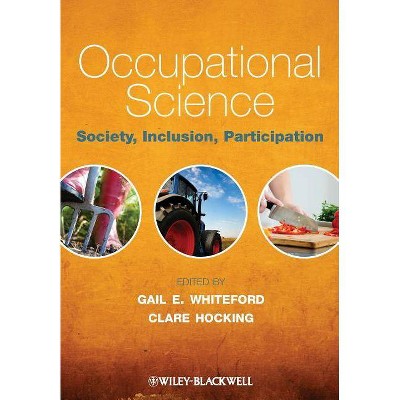
Occupational Science - by Gail E Whiteford & Clare Hocking (Paperback)
Similar Products








Products of same category from the store
All





Product info
<p/><br></br><p><b> Book Synopsis </b></p></br></br>Occupational Science: Society, Inclusion, Participation is the must have resource for occupational therapists, occupational scientists, students and researchers. The book begins with a comprehensive review of the current literature and the knowledge generated to date. Reasons for the field's limited impact are proposed, including its focus on individuals rather than groups and communities, its psychological view of occupation, and its narrow focus on socially approved occupations. Global realities such as poverty, anti-social behaviour and ageing populations are discussed and implications for action are considered.<br /> <br /> <p><br /> The second section of the books comprises a series of chapters that address the philosophical, theoretical and scientific bases that underpin and inform everyday decision making in occupational therapy practice. This is followed by a section on methodological and structural considerations. The concluding chapter offers a critical reflection on methods, strategies, values and relationships for the future, to achieve a relevant science that makes a difference to current occupational realities. Written by an internationally renowned team of contributors, this book offers a truly comprehensive critique of the field.</p> <p>Features<br /> - Internationally renowned Editors and contributors<br /> - First comprehensive text on occupational science<br /> - Fully up to date with the latest thinking and research<br /> - Links theory to practice</p><p/><br></br><p><b> From the Back Cover </b></p></br></br>Occupational Science: Society, Inclusion, Participation is the must have resource for occupational therapists, occupational scientists, students and researchers. The book begins with a comprehensive review of the current literature and the knowledge generated to date. Reasons for the field's limited impact are proposed, including its focus on individuals rather than groups and communities, its psychological view of occupation, and its narrow focus on socially approved occupations. Global realities such as poverty, anti-social behaviour and ageing populations are discussed and implications for action are considered. <p>The second section of the books comprises a series of chapters that address the philosophical, theoretical and scientific bases that underpin and inform everyday decision making in occupational therapy practice. This is followed by a section on methodological and structural considerations. The concluding chapter offers a critical reflection on methods, strategies, values and relationships for the future, to achieve a relevant science that makes a difference to current occupational realities.</p> <p>Written by an internationally renowned team of contributors, this book offers a truly comprehensive critique of the field.</p> <p>Features<br /> - Internationally renowned Editors and contributors<br /> - First comprehensive text on occupational science<br /> - Fully up to date with the latest thinking and research<br /> - Links theory to practice</p><p/><br></br><p><b> Review Quotes </b></p></br></br><br><p>"It was useful that the book chose to include and highlight the International Society for Occupational Science.... It seems to have a key part to play in the development of occupational science." (<i>British Journal of Occupational Therapy</i>, 1 February 2013)</p><br><p/><br></br><p><b> About the Author </b></p></br></br><p><strong>Gail E. Whiteford</strong>, PhD is Pro-Vice Chancellor Inclusion, McQuarie University, Sydney, New South Wales, Australia. <p><strong>Clare Hocking</strong>, PhD is Associate Professor, Department of Occupational Science and Therapy, Faculty of Health and Environmental Sciences, Auckland University of Technology, Auckland, New Zealand.
Price History
Price Archive shows prices from various stores, lets you see history and find the cheapest. There is no actual sale on the website. For all support, inquiry and suggestion messages communication@pricearchive.us