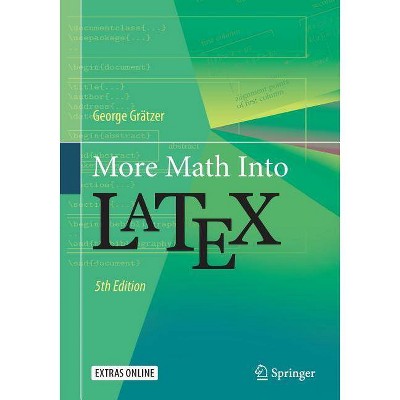
More Math Into Latex - 5th Edition by George Grätzer (Paperback)
Similar Products




Products of same category from the store
All



Product info
<p/><br></br><p><b> Book Synopsis </b></p></br></br>Foreword.-Preface to the fifth Edition.-Introduction.-I. Mission Impossible.-1. Short course.-2. And a few more things....-II. Text and Math.-3. Typing text.-4. Text environments.-5. Typing math.-6. More math.-7. Multiline math displays.-III. Document Structure.-8. Documents.-9. The AMS article document class.-10. Legacy documents.-IV. PDF Documents.-11. The PDF file format.-12. Presentations.-13. Illustrations.-V. Customization.-14. Commands and environments.-VI. Long Documents.-15. BibTeX.-16. MakeIndex.-17. Books in LaTeX.-A. Math symbol tables.-B. Text symbol tables.-C. Some background.-D. LaTeX and the internet.-E. Postscript fonts.-F. LaTeX localized.-G. LaTeX on the iPad.-H. Final thoughts.-Bibliography.-Index.<p/><br></br><p><b> From the Back Cover </b></p></br></br><p>For over two decades, <i> </i>this comprehensive manual<i> </i>has been the standard introduction and complete reference for writing articles and books containing mathematical formulas. If the reader requires a streamlined approach to learning LaTeX for composing everyday documents, Grätzer's (c) 2014 <i>Practical LaTeX</i> may also be a good choice.</p><p>In this carefully revised fifth edition, the <i>Short Course</i> has been brought up to date and reflects a modern and practical approach to LaTeX usage. New chapters have been added on illustrations and how to use LaTeX on an iPad.</p><p>Key features<i> </i></p><ul><li>An example-based, visual approach and a gentle introduction with the <i>Short Course</i></li><li>A detailed exposition of multiline math formulas with a <i>Visual Guide</i></li><li>A unified approach to TeX, LaTeX, and the AMS enhancements</li><li>A quick introduction to creating presentations with formulas </li></ul><p>From earlier reviews: </p><p><i>Grätzer's book is a solution.</i> </p><p>--<b>European Mathematical Society Newsletter</b></p><p> </p><p><i>There are several LaTeX guides, but this one wins hands down for the elegance of its approach and breadth of coverage.</i></p><p>--Amazon.com, <b> Best of 2000, </b>Editor's choice</p><p> </p><p><i>A novice reader will be able to learn the most essential features of LaTeX sufficient to begin typesetting papers within a few hours of time... An experienced TeX user, on the other hand, will find a systematic and d</i></p><p></p><p></p><p></p><p></p>etailed discussion of LaTeX features. <p></p><p>--<b>Report on Mathematical Physics</b></p><p> </p><p><i>A very helpful and useful tool for all scientists and engineers.</i> </p>--<b>Review of Astronomical Tools</b><p/><br></br><p><b> Review Quotes </b></p></br></br><br><p>"George Grätzer's books have been nearly as successful and enduring as the amazing software they are devoted to. This well known manual provides a reliable and thorough introduction and comprehensive reference for everyone who does not want to depend on various resources available online." (C. Baxa, Monatshefte für Mathematik, Vol. 192 (2), 2020)</p><br><p/><br></br><p><b> About the Author </b></p></br></br><p>George Grätzer is Emeritus Doctor of Science at the University of Manitoba. He has authored three other books on LaTex: <i>First Steps in LaTeX</i> and <i>Math into LateX, </i>and <i>Practical LaTeX.</i> <i>Math into LaTeX</i> was chosen by the Mathematics Editor of Amazon.com as one of the ten best books of 2000. Grätzer has also written many articles and a few books on the subject of lattices and universal algebra. In addition, Grätzer is the founder of the international mathematical journal, <i>Algebra Universalis</i>.</p>
Price History
Price Archive shows prices from various stores, lets you see history and find the cheapest. There is no actual sale on the website. For all support, inquiry and suggestion messages communication@pricearchive.us